The Woman and the Lake-Spirit

A girl defies her father’s wishes, refusing marriage to a man, instead calling nightly for a ke’le, a mythical being from the lake. She forms a secret bond with the creature, but her parents deceive and kill it. Heartbroken, she searches in vain, her sorrow culminating in the discovery of a skull, symbolizing loss and unfulfilled desires.

Source
The Jessup North Pacific Expedition
edited by Franz Boas
Memoir of the American Museum
of Natural History – New York

Volume VIII
1. Chukchee Mythology
by Waldemar Bogoras
Leiden & New York, 1910


► Themes of the story

Forbidden Love: The woman’s romantic relationship with the lake spirit defies societal and familial expectations.

Family Dynamics: The story highlights the conflict between the woman’s desires and her parents’ expectations, leading to tragic consequences.

Loss and Renewal: The woman’s profound grief following the loss of her supernatural lover signifies themes of loss and the search for closure.

► From the same Region or People

Learn more about the Chukchee people


This tale was left unfinished, because the next one, which was taken down earlier, and from another person, forms its continuation. The two tales form a unit; but the second half is more popular among the Chukchee, and has been found in various localities.

A girl refused to be married at the behest of her father. “To whom do you want to be married? You do not consent to be married to a man. Perhaps to a ke´lẹ you want to be married.” She paid no attention (to her father’s words). At the same time, every evening she would sing outside of the tent, “From the lake, O penis, come out!” After that she would enter (the house). Her father heard this, and said to his wife, “Oh, this daughter of ours, when we try to persuade her to marry, she quarrels with us; but to whom is she married? She is married to a ke´lẹ of the lake.” They said nothing to her.

Evening came. She went to the lake. Then she began to sing on the lake-shore. “From the lake, O penis, come out!” Then a [mere] penis appeared. She sat down upon it, and she herself copulated with it. At the dawn of the day she went home.

Then her father said to her, “Go and fetch some wood!” She obeyed. Meanwhile they went to the lake, he and his wife, and they deceived it (by this song): “From the lake, O penis, come out!” Then from the lake a penis was thrust out. They caught it and cut it off. Thus they killed it.

► Continue reading…

The wood-carrier came home. Evening was approaching. The girl quickly cooked food. Evening came. Then again she went out to the lake. Then she was secretly watched.

Again she began to sing, “From the lake, O penis, come out!” Nothing appeared. Another time, “From the lake, O penis, come out!” After that she even began to cry. “Oh, how strange!” Then again, “From the lake, O penis, come out!” Nothing (appeared).

Then she cried. She sorrowed much for the penis. Her house-mates were secretly watching her. Oh, oh! but it was not there. She finished crying, and again (sang), “From the lake, O penis, come out!” She cried much, as if she were sorrowing for a dead (husband). At last she came home. She could not do anything. On the next day she went to the open country and found a bare skull.


Running and expanding this site requires resources: from maintaining our digital platform to sourcing and curating new content. With your help, we can grow our collection, improve accessibility, and bring these incredible narratives to an even wider audience. Your sponsorship enables us to keep the world’s stories alive and thriving. ♦ Visit our Support page


The Ai´wan Shamans

This is the tale of a man cast adrift on Arctic ice, rescued by walrus spirits, and transformed into a walrus to evade capture by enemy tribes. Amid cycles of war, revenge, and diplomacy between coastal peoples, shamans wielded extraordinary powers, engaging in cosmic confrontations. Ultimately, even “Children’s Death” repents after mystical encounters, signaling hope for harmony and renewal.

Source
The Jessup North Pacific Expedition
edited by Franz Boas
Memoir of the American Museum
of Natural History – New York

Volume VIII
1. Chukchee Mythology
by Waldemar Bogoras
Leiden & New York, 1910


► Themes of the story

Transformation: The protagonist undergoes a physical change, becoming a walrus to escape his enemies.

Supernatural Beings: The story features interactions with walrus spirits and shamans possessing extraordinary powers.

Revenge and Justice: The narrative includes cycles of war and retribution between coastal peoples.

► From the same Region or People

Learn more about the Chukchee people


Told by Rịke´wġi, A Maritime Chukchee man, at Mariinsky Post, October, 1900.

Once in olden times, the Ai´wan and the people of St. Lawrence Island were at war. One man from this shore met with misfortune through the wind. While on the icefields he was carried away and spent two months on the icefields. One day there was a fog, and no land was to be seen. Then he heard the roaring of walrus. Still he remained with head drawn back into his coat. Then he was visited by another man, by a shaman, who found him sleeping on [the surface of] the ice and awakened him, “Oh, how wonderful, you are here?” The other one looked up and, indeed, he wept aloud. The shaman said, “Do not weep! A settlement, though of St. Lawrence people, is quite near.”

Then, suddenly, they saw it. They came ashore. A number of houses were there. The people were clad in bird-skin clothes. Those of St. Lawrence Island are also Ai´wan, their language being the same.

► Continue reading…

They took hold of the strangers, they took captive those two men. They bound the shaman, the other one they killed with a drill, having perforated his head at the crown. After that they set free the shaman, intending to keep him as a slave.

He passed there only one night.

When they were about to go to sleep, he went out and shouted toward the sea, calling the walrus spirit. Immediately from afar came the walrus. Oh, oh, the walrus came. Indeed, they were (as numerous) as sand. He walked along over their heads and went away. Then also the walrus which he had passed would come up in front. An old male walrus said, “Oh, now we are nearing the land. Your people are eager to pursue us. Oh, therefore some of us are going away. It seems that your people are bad.” Oh, he said to two walrus, two year old ones, “Let us carry away our guest.” By one of them he was made to sit on its body, and it dashed on, plunging along. The old walrus, the one that was most clever, followed it (like a leader). When one walrus got tired, he was made to sit on the other one.

When night came, they found a floe of sea-ice. The old walrus said, “Oh, all the people are tired. Let the people go to sleep.” They put the man on [the surface of] the sea-ice. The old walrus said to the man, “Oh, you may sleep on [the surface of] the sea-ice. We will sleep by your side on the water.” They inflated the crops on their throats and floated on the water like bladders. In due time the old walrus awoke. “Now let the people go along. Oh, my! you must be hungry.” — “Oh yes!” said the man. It was still dark. The old walrus dived to the bottom of the sea and saw something like the [motionless star] Polar Star. He bent over it and it proved to be a shellfish. The little man was fed with those shellfish. They were quite warm and even hot. Probably the walrus cook them secretly, therefore they may have been hot.

They set off and moved on till midnight. The old walrus said, “It seems we are nearing land.” They moved on, and before the land was near, the dawn came. “Oh, you must be hungry again.” — “Oh yes!” The walrus again plunged down. This time he brought some shellfish of oblong shape. He ate again. “Now we are going to leave you. As soon as we shall see a floe of sea-ice, though a small one, we shall leave you on it.” Then they saw one. “Well, your people will be here this [dawn] morning. We are beginning to feel afraid.” They put him on the ice. “Oh, what are you doing, you are leaving me alone.” — “It is quite certain, that they will come.”

Then he was told by the walrus, “When you are overtaken by sleep, roar like a walrus, when you are going to sleep.” Then the walrus dashed on, plunging on the way. They went away, very far to the open sea. Soon after that he began to be overtaken by sleep. So he roared like a walrus and immediately turned into one.

When the dawn of the day came, some people approached in a boat and began to move along towards him. Before they were too near, he awoke. Just when the bowman was going to throw the harpoon, he said, “Oh, what are you going to do unto me?” — “Oh, dear! Is it not wonderful? You have become a walrus, and we came near killing you. Oh, whence did you come back?” — “Truly, it is bad. We come from a settlement of men. My companion, however, is not with me. Those people are wrong-doers. They drilled through his head and killed him.” He entered the house. “Oh, what news?” — “Truly, it is pitiful. Evil-doers are those people.”

The summer came. They went to war, the men of Uñi´sak, and probably from every neighboring settlement a number of boats assembled. Then a large company of boats set off. All boats were overloaded (with warriors). Before they were too near, they saw a cluster of houses of the St. Lawrence people standing on the seashore. In the rear of the houses was a bay of St. Lawrence Island; there actually a large part of the boatsmen went ashore. They walked along in the fog from the rear, just out of sight of the islanders. Then an old man, one of the crew said, “Oh, howl like wolves!” They had not been seen by the St. Lawrence people and they were not expected by them. Now, when they uttered their howls, another old man, one from St. Lawrence Island, said, “Oh, now they are coming.” The young men said, “But we are on an island.” — “Give answer to them!” So they roared like walrus. Then the old man, one of the boat’s crew, said again, “Oh, where are you? Now they have become our quarry.”

The larger part, those who had landed in the rear (of the houses), were still unknown to the St. Lawrence people. Those from St. Lawrence island hid by the seashore. But those from the boats attacked them from the rear and a slaughter ensued. The St. Lawrence women were already strangling themselves from mere fright. The others, at the same time, were mincing a large quantity of walrus blubber with their kitchen-knives, (preparing a meal for the victors). It was a great slaughter. Many St. Lawrence women were put on board the boats and brought over here.

Some years passed. The fourth year, the St. Lawrence people went to war. They landed in the night-time and found the people sleeping. So they started to murder them, thrusting their spears from outside under the outer tent-cover, all around the sleeping-room, and stabbing the sleepers. A small orphan child hid himself somewhere near the house, while they were still killing some of the sleepers, and before they had time to go to another house. He awakened all the neighbors. They rushed out. Then those from St. Lawrence Island fled to the open sea. Two men staid behind on the ice-floe.

They lived on the ice-floe. Before the strong winds of autumn begin to blow, they came to steal some meat and so were taken captive. “Oh, we will not kill you.” They, however, struggled on, not heeding these words. The next night, they stole some warm clothes and departed again. They went away together over the sea-ice, they walked along over the newly-frozen sea. The ice was salt and yielded under every step.

Then they came to the shore. A St. Lawrence old man asked them, “Well, what kind of men are the land-people?” — “Oh, they are deucedly good.” — “Oh, Oh,” said the St. Lawrence old man, “Now let the (two) people become friendly to each other.”

Summer came again. “Oh well, now let the people set off.” Then the people of St. Lawrence Island came over here. They brought a quantity of p. 14 wooden vessels, walrus hides, everything they had. They landed and the people became friends. So they distributed their vessels among our people. An old man from this side said, “Indeed, what will you give as return presents?” The visitors were clothed in bird skins. “What kind of skins are these?” — “Reindeer-skins.” — “And what is a reindeer?” Then they showed them the reindeer-muzzles. They examined them. They said, “Oh, thus they are; like the holes in a boat cover, (namely in the walrus-hide cover, all along the border). [The skin of a reindeer-head with its eye-holes and nostrils resembles in a way the walrus-hide covering of the skin-boat, with its holes around the edge. The resemblance lies in the appearance of the holes.] Now then, eat some of the meat!” They cooked fat meat. “Oh, just like blubber!” They ate of it. “Oh, oh, quite exquisite!”

After that they went away. One man was left. He was a shaman, and he was treated just like the former one (i. e. he was bound). When winter came, they set him free. The shaman had a sledge. So he departed in the night-time. He was hauling the sledge loaded with walrus-blubber. He moved on until he felt tired. It was full moon. At that time he was overtaken by another shaman, one from the western country. That shaman also was hauling a sledge. The former heard only a noise above; that western shaman was flying along. On both sides he had long knives, which he used as wings. The other shaman who was hauling the sledge was startled and fled. When he was approached by the other one, just on his arrival, he also fled up with his sledge. Still, the other one was about to overtake him. Before he could catch up with him, (the other one) dived under ground, only the sledge remained there on the ground. Oh, the other one was unable to pursue him, the western shaman.

Then he sat down. “Oh, oh, oh; indeed; indeed! Not without reason was he talked about. Really I am much interested in seeing you.” It seems that shaman was called Ke´mneku. [This passage is not clear. The narrator did not know exactly what each shaman did.] “No shaman from any country whatsoever can vanquish me.” Then Ke´mneku spoke to the ground downward. “Nevertheless you have frightened me. I thought you were a ke´lẹ. Now come here.” He appeared. “Give me your necklace. Let me give you this knife in exchange.” — “No, I do not want to give it to you.” — “Then I shall not be believed. Please, do give it to me.” — “No, I won’t.” — “Then I will give you this big knife. Please, give me your necklace.”

Then they exchanged their (assistant) spirits. And the other one gave him the necklace. He gave him the knife. The western shaman said to the other one, “Now then, move about with the knives.” All at once the other one moved upwards in this manner. Then Ke´mneku said, after they had exchanged even their bodies, “Well, now put on the necklace; go away and fly up, just as I did. You will fly up, then sink down to the ground and plunge in.” The other one flew up. Then, slowly moving he fell down, plunged into the ground, but (when he was in as far as) the middle of his body, he stuck fast. “Oh, I have been unable to do it. Give me your wrist-bands!” — “I will not give them to you.” — “Then I will give you the tassel from my back. It is my tail, my guide in motion.”

Then he consented. The western shaman said to him, after the tassel had been given [then he said to him], “Well now, fly up just as I did.” He [himself] flew up and just went up clattering. The shaman from St. Lawrence Island said to the other one, “Well, now it is your turn.” He gave him the wrist-bands. “You will fly up, then you will fall down again and plunge into the ground.” Then the western shaman flew up. Slowly moving he fell down. Then he plunged into the ground and was submerged as in water. After a while he re-appeared. He said, “Oh, oh, indeed; Ke´mneku is talked about. How is it now? I am unable (to pursue him). Still before this in my own mind I thought I could hardly be pursued by anyone. Oh, oh, truly; Ke´mneku has been talked about. How is it now? You have vanquished me. Oh, let us go away!” Then the western shaman flew up. They were travelling at night. In one night they travelled flying through every land. Ke´mneku said. “I am going away.”

The western shaman came home. He said to his companions, “I saw a shaman from St. Lawrence Island. I was unable to follow him.” — “You lie.” — “Indeed, it is true.” — “Well then, what kind (of a shaman) was he?” He showed the necklace. “This is his necklace.” — “You lie. You have stolen it somewhere.” — “Indeed, no!” — “Well then, what kind (of a shaman) was he?” Then he flew up with easy motion, then fell back to the ground and plunged in, as though it had been water. “Oh, really, you have acquired new shamanistic powers.”

His father said to him, “Well now, let us see, whether he has really acquired new shamanistic powers. Go on, look for Children’s-Death.” He flew away night after night and travelled among all kinds of beings. Nothing. He came back to the house. By his father he was told, “What is the matter with you? You cause delay. Oh, surely he lied (to the people).” He departed again. This time he went underground. Then he came back and said, “I have been unable to do it.” By his father he was told, “Oho, what is the matter with you?” By his son, the western shaman, (the father) was told, “Oh, but I could not find him among any kind of beings.”

After that he went to the Being-of-Darkness. Then at last he saw a man; a mere mouth. This was Children’s-Death. By the Darkness he was questioned, “What do you want?” — “By my father I have been sent. I was told, ‘Go and look for Children’s-Death.'” — “Oh, oh, and for what purpose?” — “Only to show him to the people.” — “Well, surely, he is in my neighbor’s house.” He went there. There was an old man who dwelled in those regions, a mere mouth, smeared all around with dried blood. The shaman entered. “Oh, at last I see you.” The other one questioned him. (He replied,) “By my father you are bidden to come.” — “And for what purpose?” — “He said thus, ‘I want to see the old woman yonder.'” [At first Children’s-Death is called a man, now a woman.] She refused to go. “For what purpose?” — “They only want to see you. My father said, ‘Go and look for Children’s-Death.'” — “Oh, but I refuse.” — “Please come! It seems they will not believe me.”

Then she consented . She said to him, “Sit down on my body.” Then she flew up with him. A great noise spread around. It was very loud. And the whole world clattered and resounded. His father said, “Oh, what is the matter again? The world is full of noise. It appears that really he has acquired new shamanistic powers.” In coming he let her plunge underground, and after that appear in the outer tent. “What luck?” — “It seems that this time I brought Children’s-Death.” — “Now bring her here. I want to see her.” She was as large as a tree. Still she decreased in size very quickly; and he put her on the palm of his hand before he showed her to them, so small had she come to be. Before she dwindled away, he spat on her, and she grew again. Then, on becoming thus, she decreased again in size. He made her plunge underground, then he made her appear. Then he took her in the other hand, and she became as large as before.

“Oh, that is you! You are the source of sorrow among every kind of beings, to those that have children. To whomsoever a child is born, it dies suddenly, and you are the cause of it. You are Children’s-Death. Now we will bind you.” They tied her with thongs, but she broke them all. Then they tied her with a grass-blade. She was struggling the whole night, but the grass-blade proved to be tough, (it could) not be broken by her. The whole night through there was clamor and weeping. Then they said to her, “Will you do evil the same as before?” — “Oh, no! not now; not from now on. I will cease doing so.” — “Oh, but it seems to us, you will do evil again. You are bad, you are the source of trouble. You kill new-born children.” — “Oh, no! I have been made to obey by the angry ones (evil-minded conjurers). From now on, I shall not obey them. I repent having done so (heretofore). Oh, indeed! Set me free.” — “But it seems you will do evil again. Well, we will set you free.” — “From now on, I will turn to the Life-Giving-Being. Now the new-born child shall grow up, it shall die only in its old age.” Then they set her free.

She departed. Darkness asked her, “Well, how were you treated by the human beings?” — “Oh, I have been cruelly treated by them. Now I repent. Whatsoever I may be ordered to do by the angry ones, from now on I shall not obey them.” Darkness said, “That is your way. Though you say now, ‘I shall not obey the angry ones,’ still you lie. It seems, when you will be hungry again, you will comply again with their requests.” Nevertheless, when the angry ones spoke again, she paid no attention to them. Oh, but are the children dying only owing to the angry ones?

Again the (shaman’s) father sent him, “Go and look for Death, by whom people are killed.” Then again he sought among all kinds of beings, but could not find him. “What luck?” — “Oh, nothing.” — “Oho, I thought you were a shaman!” He departed again, this time underground. Again he could not find Death, and came back. “What luck?” — “Oh, I could not find him.” — “Oh, but what is the matter with you?” That was a wonderful father. Then he travelled along the crevices in the ground, and saw Iu´metun. [Iu´metun is a spirit of nightmare, living in the open country and hiding in the crevices of the ground. He is much dreaded by the Chukchee.] Iu´metun was black like coal, and had only three fingers on each hand. “Oh, that is you. You are the source of death.” Iu´metun said, “What do you want?” — “I have come to visit you.” — “Oh, now you are meddling again with my affairs. No live being has ever been able to see me, and now you have seen me. I was not, however, to be seen by anybody.” — “My father bids you come.” — “Where to and for what purpose?” — “They only want to see you.” They departed. “What luck?” — “Yes, now I have brought him.” — “Well, bring him here.”

Then he showed him to them. He was no larger than a reindeer-fly. “Ah, here you are! You are Iu´metun. You kill everybody without illness. We say, ‘How wonderful, what has killed him?’ And it is you.” — “No, I am not the one.” — “Indeed, you are the one. If you are not the one, then, indeed, I cannot become black. But if you are really Iu´metun, I shall become black from you.” — “No, truly, I am not the one. Set me free.” Indeed, he renounced his own body. “Now we will bind you.” Meanwhile he was induced to touch the man’s skin. All at once the place where he had been touched reddened, and then became black. “What now, then? Indeed, you are Iu´metun.” — “Oh, truly I am not he.” — “Yes, you are. You are evil, you are a source of trouble. Why do you meddle with the affairs of man?” — “Oh, the Ground-Beings (evil spirits) tell me to do so.”

“Also, when a man is alone in the open country, you meddle with him. Oh, we will tie you up.” — “Oh, set me free! From now on treat the clefts of the ground with offerings. And when a shaman accuses me as the cause of suffering of a man, that shaman shall be able to cure him. Every source of illness of man shall be seen by the shamans, and even by merely breathing on the skin, they shall set (the sick) right. Also when a ransom is paid to the spirits, a single bead shall be used by the shaman as a sufficient payment. But when in a serious illness a reindeer is presented as ransom, let it be a buck, well broken, because if it struggles, it is not good for the suffering body. Also by incantations suffering shall be alleviated.” Then the old man said to him, “You lie.” — “No, I do not. I was not a murderer of my own free will; the Ground-Beings told me so. Set me free. Now, even when an orphan-child wanders alone in the open country, I shall not meddle with him. Indeed, also an orphan-child shall be able to sleep safely in the open country.” — “But surely, you deceive us.” — “No, indeed! Set me free. Now I shall turn to the Merciful-Being, and I will help every orphan-child. I have been induced to do wrong by the Ground-Beings. From now on, let the Ground-Beings be placated by offerings. Let a dog be killed, let it be stabbed (with an iron knife). Also let blood be sprinkled on the ground. Sausages let also be [stabbed] offered. The Sea-Beings also must be made friendly, When the people are unable to find game, something small may be used, a small root of Polygonum viviparum. It must be thrown into the sea. Then sea-game shall appear again, and all kinds of sea-game shall be taken. Also a man who has trouble with his young children may call as a shaman a little old beggar-woman. [Among the Pacific Chukchee, čata´m-yêɛ´čhịn means “beggar-woman,” though both words signify “moon.” Some tale must underlie this term, but I have been unable to secure it.] Then the child’s clothes must be pinned in some unusual manner. Let them be quite friendly to the conjurer. And when the conjurer comes, let them give her some small presents. She may take home some sausage. A part of it has to be thrown to the Incantation-Beings. Then the child shall cease to suffer. Oh, set me free! They set him free. Unfortunately he proved a liar.

The end.


Running and expanding this site requires resources: from maintaining our digital platform to sourcing and curating new content. With your help, we can grow our collection, improve accessibility, and bring these incredible narratives to an even wider audience. Your sponsorship enables us to keep the world’s stories alive and thriving. ♦ Visit our Support page
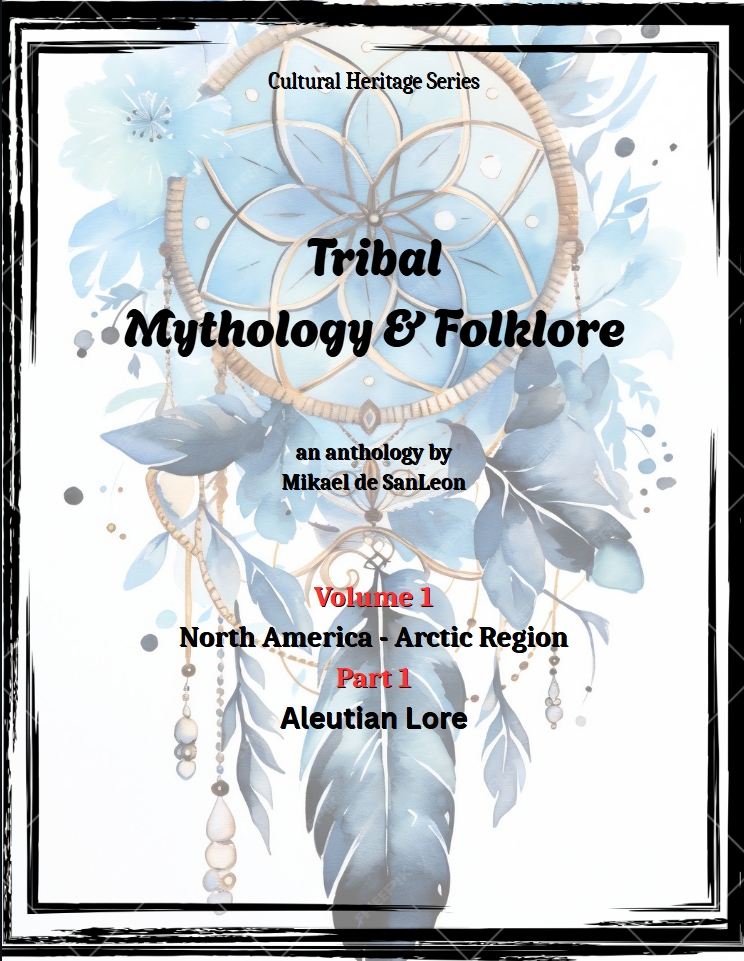
Aleutian Lore: the Book

Collector’s Edition

The volume contains the 33 stories from the Journal of American Folklore (recorded by Frank Alfred Golder between 1903 and 1907) and the American Anthropologist (recorded by Rev. T. I. Lavrischeff in 1928) published in our site, with many additional notes and comments from the original authors.
Free access to all our supporters.

Old Man of Nutchek

A wealthy man named Anoogne, proud of his abundant stores of food, mocked a divine warning about his reliance on nature’s provisions. In response, relentless snow buried the land for two years, freezing his supplies and causing widespread starvation. Humbled and remorseful, Anoogne admitted his folly, learning the harsh cost of arrogance and ingratitude toward nature’s gifts.

Source
Two Aleut Tales
recorded by Rev. T. I. Lavrischeff
American Anthropologist

Vol. 30, Issue 1, January-March 1928


► Themes of the story

Divine Punishment: Anoogne’s arrogance and dismissal of the divine warning lead to a severe punishment from higher powers, resulting in a prolonged snowstorm that devastates his resources.

Conflict with Nature: The story highlights the struggle between Anoogne and the natural forces, emphasizing the consequences of underestimating and disrespecting nature’s power.

Moral Lessons: The narrative imparts a lesson on humility and the importance of respecting nature, illustrating the perils of pride and ingratitude.

► From the same Region or People

Learn more about the Aleut people


Long, long ago rich Anoogne lived in the village on Hinchinbrook island, keeping rough storehouses with their stone shelves filled with valuable furs, many clothes and all kinds of native foods. He preserved many fish and eggs in the ground, for sour fish dug from the earth formed his favorite repast. All of the villages about worked for the Anoogne and often he gave feasts in his house and the guests praised him highly for his generous deeds. One evening, the Anoogne took a walk on the seashore. The sky was blue, the sea was calm and the old man enjoyed his slow promenade. Suddenly his foot slipped and he fell. He had stepped on a dead fish cast on the beach.

► Continue reading…

Anoogne started to complain bitterly, but a voice came from on high, saying: “Do not scold. Do not curse the old fish. If I did not give to you the same fish for your food you will starve.”

“If you did not send this fish, I will not starve,” the Anoogne replied.

“Why not?” the voice asked.

The old man told him, “I have all kinds of fish. I have all kinds of meat, enough to keep me forever. My stores are filled with halibut, seal, bear, salmon, codfish, and mountain goats. I shall not lose the food I have stored.”

But the voice continued, “Remember, Anoogne, very soon you shall be the most miserable man and thy riches shall not be of use to thyself.”

Never, never,” replied the excited Anoogne. “I am the wealthiest of the natives and I shall never grow poor.”

“What will you eat if your food freezes over?” he was asked.

“I have dried fish and meat and have buried fish eggs, a reserve that will last a long time.”

“I can send the deep snow to cover the earth,” he was told.

“Do not think you can even cover the koongat, the edible trees?’’ the haughty Anoogne responded.

No reply came, only repeated in gradually dying echoes, the sound of the word “ahtat.”

Then the big flakes of snow started to fall softly over the earth. When the Anoogne approached his house the snow was up to his knees. His food had frozen and become like paper. The old man and his helpers started to shovel the white blanket, but such great flakes fell this work soon appeared useless. The snow even passed through the roof and filled the barabaras.

Again came the voice from on high, “There you have it.”

All of the island was covered by deep snow for twenty-four months. All living creatures perished. There was no food on land, there were no fish in the sea.

Anoogne began to starve. Greatly did he regret his mistake and his conceit. He called his neighbors and confessed his sin.

Then the voice came again, saying, “Do not speak bad words. Do not curse the food I send you. Do not grumble against fate.”

So ended the story of the richest old man of the ancient village of Nutchek.


Running and expanding this site requires resources: from maintaining our digital platform to sourcing and curating new content. With your help, we can grow our collection, improve accessibility, and bring these incredible narratives to an even wider audience. Your sponsorship enables us to keep the world’s stories alive and thriving. ♦ Visit our Support page

The Unfaithful Husband

At Eekakhlee, a shaman feigned death to escape his wife and live with two young women far away. Guided by a bird, the wife found him and, in vengeance, killed the women. Transforming into a bear, she confronted her husband and devoured him and his belongings, exacting retribution for his betrayal. Thus ended the shaman’s deceitful life.

Source
Two Aleut Tales
recorded by Rev. T. I. Lavrischeff
American Anthropologist

Vol. 30, Issue 1, January-March 1928


► Themes of the story

Revenge and Justice: The wife’s actions in seeking out her husband and punishing him for his betrayal highlight themes of retribution.

Transformation: The wife’s metamorphosis into a bear signifies a physical change driven by emotional turmoil.

Love and Betrayal: The narrative is rooted in the husband’s betrayal of his marital bond and the ensuing consequences.

► From the same Region or People

Learn more about the Aleut people


Eekakhlee was the name given in the old days to present Johnstone Point on Hinchinbrook island, and the mountains between there and Nutchek were called Keeliagat.

At Eekakhlee lived an old man with his wife. They existed comfortably, but the old man did not love his spouse and hoped to desert her. As he was a shaman, or sorcerer, it was easy for him to go into a trance and appear as dead.

His wife buried him, according to custom, in a cave on a mountain, and his bows, arrows, clothing and bidarkas were laid beside him in a cavern.

For three days the disconsolate widow came to the cave to weep and wail. When she came on the fourth day she did not find the body nor the bidarkas and clothing. Stupefied, she stood there puzzled by the disappearance of the corpse. Search for traces of it were fruitless and her grief increased.

► Continue reading…

But a little bird on a tree sang to her:

“Cheer up, thee! up.
“Far beyond the Kiliagat the old man lives.
“Cheer up, cheer up.”
“Far more than before, he enjoys his life.”

At first the woman paid no attention to the bird and went to her house. On the next day she renewed her search, but the bird again sang the same song. The old woman asked it, “Where is my husband?” At this the feathered creature chirped:

“On the top of the mount,
Near the peaceful bay,
The old man lives quietly there.
He does not love thee,
He will not come back;
Two nice girls entertain him there.”

Still skeptical the old woman replied, “If you tell me the truth, take flight to the place where he lives.” Thereupon the bird set out, with the Woman following silently.

It was a long journey across the forest, through brush and over mountains, but from time to time the bird rested, permitting the old woman to catch up with it. Finally they came to the top of a hill near the bay at Nutchek. From this spot the wife saw her husband in a bidarka far out to sea. Just below her on a sandy beach she espied two attractive girls. Quietly descending, the old woman stopped behind a tree to observe them. The girls were cooking soup and when it was ready she stepped out.

“Hello, girls,” the wife exclaimed, “I see you have prepared your soup in the right way. Now I will show you best how to drink it.” With this she seized the pan and turned it over the heads of the girls.

“That is the way the old man used to eat his soup in our birthplace,” she gloated.

When both girls were dead the old woman made the feature of one appear as though she were scolding and the other seem to be laughing. Then she set their bodies on the beach and again hid herself behind a tree.

The old man came back and saw the maidens, one apparently angry and the other laughing.

“Why do you quarrel?” he asked. “Live in peace. I love you both. I have brought two otters as a present for you. Do not fight.”

Upon hearing these words the old woman turned herself into a bear, an easy thing for her to do, as she was also a shaman. Then she sprang upon her husband, exclaiming, “Here am I – your wife. You left me without your care and food. I have suffered very much. Now that I have found you here you shall die. Akcheenkoo.”

And with that she ate up the old man, together with his bidarkas.

Such was the end of the unfaithful husband of old Eekakhlee.


Running and expanding this site requires resources: from maintaining our digital platform to sourcing and curating new content. With your help, we can grow our collection, improve accessibility, and bring these incredible narratives to an even wider audience. Your sponsorship enables us to keep the world’s stories alive and thriving. ♦ Visit our Support page

Ughek

In a large village, Ughek, a disliked half-witted man, is abandoned by his community. Facing loneliness and the threat of a sea-monster, he devises a plan, using a stone as a trap. The monster is killed, and Ughek cooks its meat. When villagers return, he tricks them into eating the cursed feast, killing them all, and lives alone with his stone forever.

Source
Eskimo and Aleut Stories from Alaska
collected by F.A. Golder
The Journal of American Folklore

Vol. 22, No. 83, Jan. – Mar., 1909


► Themes of the story

Revenge and Justice: He seeks retribution against the villagers who mistreated and abandoned him.

Conflict with Nature: The confrontation with the sea-monster represents a struggle against natural forces.

Community and Isolation: Ughek’s initial isolation and subsequent actions highlight themes of belonging and estrangement.

► From the same Region or People

Learn more about the Aleut people


Karluk story

In a large and populous village lived a half-witted man named Ughek. On account of his meanness he was much disliked by all the people. To the evening parties where the men gathered in the large hall to play, sing and dance in a circle, he was never invited. The women were not permitted to take part in these festivities; but when bringing in the cooked seal-meat, ducks, and berries and oil, for the men, they were allowed to dance in and, after depositing the food, to dance out again. Ughek, who resented the treatment he was receiving, got even with his neighbors by hiding near the dance-hall; and as the women passed, he plucked the dress of one, pinched a second and tripped a third, and in this way made himself thoroughly disagreeable to the community.

► Continue reading…

The chief determined to put up with him no longer. He therefore called a meeting, which decided to leave the village for a time; but Ughek should not be taken. The next day the village, except for Ughek, was deserted. For two days he did not mind his new situation; but at the end of that time he began to fear lest the schwichileghk (sea-monster, half-human and half beast, which is covered on the body with sea-shells and on the head with kelp) would come out at low tide and eat him, as he had done to others.

On the evening of the third day he gathered all the oil lamps from the other barabaras into his own, filled them with oil, and lighted them. This done, he played on the drum, sang, and danced. Every now and then he turned his head toward the beach, and once his attention was drawn to a stone. He went out to it, and said, “You are here alone, as I am. It is lonely for you. Come with me. In the barabara where I am it is pleasant, many people are dancing. Come with me.” Since the stone made no answer, he attempted to force it to come with him by carrying it, but he could not lift it. He went once more into his hut, continuing his singing. Again he approached the stone, asking it to share his joys, and again the stone refused. The attempt to move it was a little more successful, for he advanced it two steps at least. He went back to his music, and from there to the stone. The third time he transported it as far as the doorstep. He danced and sang a little more, and finally got the stone inside, and said, “I am all alone. The people have gone and left me to starve. I am afraid of the schwichileghk. I will put you over the door, and, if he comes, you fall on him and kill him.”

Having placed the stone over the door, Ughek was free to go on with his entertainment. About midnight his joy was cut short by the odor of kelp, which became stronger with each minute. Ughek had his eyes on the skin door, which fluttered, and through which a moment later a head of kelp was seen, and from it these words came in a roaring voice: “It has been a long time since I have eaten anything, but now I shall have a good feast.” The schwichileghk, for it was he, advanced slowly, but when about halfway in, the stone fell down and killed him.

Ughek raised the stone, cut the monster into small pieces, which he cooked, and filled all the dishes he could find in the village. Not many days later the villagers returned, and Ughek, on hearing them, ran off and hid. Not seeing any trace of Ughek, the chief and his people concluded that he was dead, and celebrated the event with a dance. As the women were advancing with their cooked meats, Ughek sneaked in and played his old tricks on them. One of them ran into the dance-hall, shouting excitedly, “You thought Ughek dead, but he is not. He just now tripped me.” It was decided to call him in, and invite him to tell all that happened to him during their absence. Ughek came in, and began playing on the drum, singing and dancing. That done, he asked permission of the chief to set refreshments before the people. When this was granted, he went out and brought in the cooked schwichileghk. Each person took a piece of meat, chewed and swallowed it, and dropped dead. Ughek himself returned to his hut to live with his stone, and there he is now.


Running and expanding this site requires resources: from maintaining our digital platform to sourcing and curating new content. With your help, we can grow our collection, improve accessibility, and bring these incredible narratives to an even wider audience. Your sponsorship enables us to keep the world’s stories alive and thriving. ♦ Visit our Support page

The sinew rope

A young man, struggling as an unsuccessful hunter, defies his mother’s advice and discovers a sinister figure intending to feast on him. Pretending to be dead, he endures pain to maintain his ruse before escaping with a magical sinew rope. This artifact brings him exceptional hunting success, transforming him into a celebrated provider and symbolizing resilience and the rewards of courage.

Source
Eskimo and Aleut Stories from Alaska
collected by F.A. Golder
The Journal of American Folklore

Vol. 22, No. 83, Jan. – Mar., 1909


► Themes of the story

Transformation: The protagonist evolves from an unsuccessful hunter to a renowned provider, symbolizing personal growth and change.

Cunning and Deception: The young man uses cleverness to feign death and escape from the sinister figure, highlighting the use of wit to overcome danger.

Sacred Objects: The sinew rope serves as a magical artifact that brings the protagonist success, emphasizing the significance of powerful objects in myths.

► From the same Region or People

Learn more about the Aleut people


Kadiak story

There were a great many successful hunters in a certain village; but one there was who had never killed anything, and he and his parents lived off the game secured by others. This humiliated the young man very much. He asked his mother why he in particular was so unfortunate, and what he ought to do to have better luck.

His mother advised him to go to the point of the cape and look about, but under no circumstances to go farther. He set out, and, when reaching the designated spot without seeing anything of note, he decided to go on until something happened. Towards evening he came to a beach, and in the sand he detected fresh human footsteps.

► Continue reading…

After pulling up his boat on the kelp, he threw himself alongside of it, giving the impression of having been thrown up by the waves. He lay there a short time when he heard footsteps followed by a voice saying, “Ha, ha, here is another one! “The young man was carefully examined by the new-comer to make sure that he was dead; then tying a sinew rope about the body, the person swung him on his shoulders and walked off. On the way they passed through alder-bushes; and when a good opportunity offered itself, the young man reached out and gave a strong pull at a bush, almost upsetting the bearer, who called out, “Who is pulling me?”

When they reached a barabara, the young man was conscious of a woman and several children gathered about him in the expectation of a feast. The baby coaxed so much for a piece of meat that the father told the mother to cut off a toe for the child. Painful as the operation was, the young man did not in the least betray his feelings. The man had started a big fire and was sharpening the knives, when his attention was drawn to the choking baby, who had attempted to swallow the toe but could not. While the whole family was assisting the baby, the young man decided it was about time to escape. So he made a dash for the outside, and ran as fast as he could to the beach for the boat. He had barely time to get in it and push out, when the other man came up and said, “Give me back my sinew rope, and I will give you something also.”

The young man, however, refused to have any dealings with him, and pulled away, taking the rope with him. On the way home he killed much game; and as long as he retained the rope he was successful, and in time became a renowned hunter.


Running and expanding this site requires resources: from maintaining our digital platform to sourcing and curating new content. With your help, we can grow our collection, improve accessibility, and bring these incredible narratives to an even wider audience. Your sponsorship enables us to keep the world’s stories alive and thriving. ♦ Visit our Support page

The woman without a nose

An Aleut hunter deceives his wife, feigning death to join another woman. Guided by a bird’s message, his wife discovers his betrayal, kills his mistress, and confronts him. Overwhelmed by guilt and shame, the man drowns himself in the sea. This myth explores themes of loyalty, deceit, and the emotional toll of betrayal within isolated lives.

Source
Eskimo and Aleut Stories from Alaska
collected by F.A. Golder
The Journal of American Folklore

Vol. 22, No. 83, Jan. – Mar., 1909


► Themes of the story

Love and Betrayal: The husband’s deceit and abandonment of his wife for another woman highlight themes of infidelity and treachery.

Cunning and Deception: The husband’s feigned death to pursue a new relationship exemplifies deceitful behavior.

Revenge and Justice: The wife’s actions in discovering the betrayal and confronting her husband underscore themes of retribution and the restoration of moral order.

► From the same Region or People

Learn more about the Aleut people


Belkovsky story

At the head of a long bay lived a man and his wife apart from other human beings, of whose existence they were hardly aware. Every pleasant morning the man went hunting, returning in the evening with a bidarka full of seal-meat. One day, however, he failed to come back at the usual time. This made the woman uneasy, and she kept a look-out for him; and when he finally appeared, he had only one small seal. To the numerous questions of the wife he merely replied, “The seals are scarce, and I have to go far to get them.” She believed him. The next day he was again late, and had the same hard-luck story to tell. He looked worried, ate little, and refused to talk. Occasionally he would be gone two and three days at a stretch, returning with but little game.

► Continue reading…

Finally he told his wife that he was ill and about to die, and made her promise that when that sad day should come, she would dress him up as if he were going hunting, and leave him with his boat and weapons in the open air. A few days after this conversation she found him dead, and she faithfully carried out her promise. In the evening, being exhausted from much weeping and hard work, she went into the hut and fell asleep.

When she woke up, neither husband, nor bidarka, nor weapons were to be seen, but on the beach she discovered tracks made by her husband in carrying the boat to the water. “Ai, Ai, Y-a-h. This is why he died, and asked to be buried in this manner!” For a whole day and night she sat as if stupefied, trying in vain to solve the mystery. After the first shock was over, she did the best she could to adjust her life to the new conditions and accept the inevitable. But one day while she was cutting grass, a little bird perched itself on a bush near her and repeated three times, “Mack-la-cluili woani.” The woman listened attentively, and concluded that the bird meant for her to go in search of her husband. She hurried home to put on her torbasas (soft skin shoes) and belt, and set out. Over hills and valleys she walked before she came in sight of a bay, where she noticed a man in a bidarka fishing, and she suspected him of being her husband. Not far from her was a hut, to which she directed her footsteps; and on going in, she saw a woman around the fire cooking seal-meat. A better look at the woman disclosed the fact that her face was quite flat; there was not even a sign of a nose. Yet she sniffed the air and said, “Fati. I smell a human being. Where did it die, on sea or on land?” — “I died neither on sea nor on land,” said the new-comer, “but came to find my husband.” On the floor was a large knife, which the visitor picked up unperceived, and, watching her chance, attacked the noseless woman and cut her head off. Her body was carried outside, the head replaced, and she was made to look as natural as possible.

This done, the deserted wife hid near by to await the coming of her faithless husband. As he approached, he called, “I am coming!” but receiving no reply, he shouted again, “I am coming!” Still no reply. A third time, “I am coming! Are you angry again today? I did not go anywhere.” When he pulled up his bidarka, he spoke again, “Why are you angry? Here I am.” He went up to his mistress, and, on touching her, the head fell off. Just then his wife appeared, and said, “This is how you died.” He looked at her and then at the mistress, and began to weep. Turning his back on both of them, he got into his bidarka, pulled away a short distance from the shore, turned it over, and drowned himself.


Running and expanding this site requires resources: from maintaining our digital platform to sourcing and curating new content. With your help, we can grow our collection, improve accessibility, and bring these incredible narratives to an even wider audience. Your sponsorship enables us to keep the world’s stories alive and thriving. ♦ Visit our Support page

The Old Man of the Volcano

An Aleut man abandons his family for another woman, prompting his wife to transform into an eagle and kill him. Their son, aided by magical gifts, braves a perilous river journey and encounters supernatural foes, including a fiery volcano spirit. Through wit and resilience, he survives, ends the threats, and marries a village chief’s daughter, securing peace for his people.

Source
Eskimo and Aleut Stories from Alaska
collected by F.A. Golder
The Journal of American Folklore

Vol. 22, No. 83, Jan. – Mar., 1909


► Themes of the story

Transformation: The protagonist’s mother transforms into an eagle to confront her unfaithful husband.

Quest: The son embarks on a perilous journey upriver, facing various supernatural challenges.

Supernatural Beings: Encounters with entities like the fiery volcano spirit and other mystical adversaries.

► From the same Region or People

Learn more about the Aleut people


Told as a Nushigak story by a native of Karluk

On the eastern side of a river was situated a populous village; on the western bank there was but one barabara in which lived an old couple with their son. The old people were feeble, and did not think they had long to live; they therefore asked their son to go over to the village and get married. He did as he was bidden, crossed over, married, and came back with a wife. Not long after this event the father and mother died, leaving the young couple alone. At the end of the first year of the marriage a daughter was born, who, after being bathed two or three times, began to talk. Another year passed, and a little boy came to the family. As the children grew up the father became very fond of them, particularly of the boy, who very often went down to the beach to meet him as he returned from his work.

► Continue reading…

For in order to provide for his little family, the father went out daily in his boat to hunt for sea animals and birds, and always came back well loaded.

But one day the man came home with little game and looking very sad. His wife asked the cause of his unhappiness, and he answered roughly that seals were scarce. From that day on, the poor woman could not depend with any regularity on his home-coming. Sometimes he would not put in an appearance until late in the night, and frequently he stayed away two or three days together. He brought so little game that the family had barely enough to live on. When at home, he was dejected and could hardly be made to talk. His wife’s questions were generally cut short by brutal answers.

Things kept going from bad to worse, and the climax was reached when the man disappeared altogether. Days and weeks passed without bringing any tidings of his whereabouts. In looking over a basket filled with various objects, the woman came across the head and claws of an eagle which had been given her when she was a girl. These she shook and worked on until she made a large eagle’s skin, which she put on herself and flew away to find her husband, who, she feared, was starving or lying ill somewhere. She flew a long time, and came to the outskirts of a large village, alighting near a barabara alongside of which bubbled a spring to which the women came for water. From where she was, the eagle could see a bidarka with her husband in it coming towards the shore. At the same time her attention was drawn to a young woman running to the spring to fetch some water, and, after leaving it in the hut, hurrying down to the beach to greet her faithless husband. Following her rival, the eagle swooped down on the man, and, snatching him in her claws, flew with him into the clouds, from whence she dropped him into the sea.

From this tragedy the eagle flew home to her children, whom she found safe. To the boy she gave a feather and a pebble to eat, which he did. Up to this time all those who had gone up the river failed to return, no one knowing just what had become of them. The boy, when he grew up, told his mother that he had made up his mind to go upstream. She tried in vain to dissuade him from his enterprise by pointing out the dangers and citing cases of strong and brave hunters who had lost their lives in the undertaking. Seeing that he was determined, she yielded, and gave him to take with him a needle and this advice: “If you are in trouble, think of the feather; should no help come from that, remember the pebble; and if very hard pressed, make use of the needle.” The next morning he got into his boat and paddled upstream until he came to a cave into which the tide was setting with such force that he was unable to keep out of it. In the cave he felt a current of warm air and saw a smooth beach, on which he pulled up his bidarka. Pretty soon afterwards he became aware of some one approaching, and great was the boy’s fright when he saw near him a large old man breathing fire. There was, however, no harm done him, except that the old man asked him to follow. They marched into the interior, passing through dark and hot places, gradually ascending to lighter and cooler atmosphere, until they stood on the summit of a mountain whose sides sheered straight down into the sea. “If you wish to live with me,” said the old man, “you must jump off this bluff;” and with this he gave him a push, and the boy felt himself going down, down. He thought of his mother’s advice about the feather, and by doing so became a feather and was carried by the wind back to the top of the mountain. There he resumed his human shape, and went back to his boat and proceeded in his ascent of the river, coming to a bay partly inclosed by steep black walls. In the distance, at the head of the bay, a barabara was visible, and thither the boy pulled and landed. He went in and found a very stout old woman and a young girl, who began to weep when she saw him.

“Why do you weep?” said the old woman. “Who is dead or drowning at sea?” — “I am not drowned. I died neither on land nor on sea,” answered the boy. “If you are alive, come in; but if dead, stay out.” — “I am alive,” he replied, and went in.

When a few questions had been asked and answered, the old woman proposed that the young couple should marry, which was done. The young wife did not love her husband, and begged the old woman to have him killed for fresh meat, but the latter put her off by saying that he was not fat enough. At last the old woman consented to have him killed, and for this purpose told him to go to the top of the hill, to the home of her brother, and there take a bath. He suspected treachery, and was on the lookout.

At the top of the hill a stout old man waited for him to take him to the bath-house, and urged him to hurry with his bathing, for he had a hot roasted codfish waiting for him. When the boy went in, the old man closed up all openings and poured hot oil on the heated rocks in order to smother him; but the boy changed himself into a pebble, and remained so until the door was opened and fresh air blew in. On seeing him come out unharmed, the old man exclaimed, “Ah, you are different from the others!” After having eaten his roasted fish, the old man proposed to the young one to take a run along the edge of the cliffs. This proposition was accepted on condition that the old man take the lead. They started off; and when they reached a steep and dangerous place, the boy shoved his companion off, and he disappeared out of sight. From here he returned home, where he found his wife sitting near the fire and the old woman soundly asleep. His wife he called outside and shot her with the needle his mother gave him, and then he shot the old woman with the same weapon.

Having had enough adventure, he started down the stream to where his mother was; and to her and others he related all that had happened to him. The chief of the village was so delighted that he gave him his daughter in marriage. After that time no harm came to those who went upstream; but they must not approach the cave at flood-tide, for they will be drawn in.

Each volcano has a master. He breathes fire, and he it was who met the boy in the cave. This old man of the volcano does not like rivals, and kills all who come in his way.


Running and expanding this site requires resources: from maintaining our digital platform to sourcing and curating new content. With your help, we can grow our collection, improve accessibility, and bring these incredible narratives to an even wider audience. Your sponsorship enables us to keep the world’s stories alive and thriving. ♦ Visit our Support page

The woman who became a bear

An Aleut husband fakes his death, abandoning his wife and children to live with another woman. Guided by a bird’s warning, the wife discovers his betrayal, murders the rival, and dons a bear skin. When confronted, the husband’s pleas for forgiveness fail. Consumed by rage, she kills him, her children, and retreats to the wilderness, becoming a savage bear.

Source
Eskimo and Aleut Stories from Alaska
collected by F.A. Golder
The Journal of American Folklore

Vol. 22, No. 83, Jan. – Mar., 1909


► Themes of the story

Love and Betrayal: The narrative centers on the husband’s deceit and abandonment, leading to the wife’s feelings of betrayal.

Revenge and Justice: In response to her husband’s infidelity, the wife seeks vengeance by killing his new partner, him, and eventually her own children.

Family Dynamics: The story delves into complex familial relationships, highlighting the impact of the husband’s actions on his wife and children.

► From the same Region or People

Learn more about the Aleut people


Kadiak story

On the bank of a river lived a man with his wife and several small children. One day the husband told his wife that he was ill and going to die, and requested her that when dead she should leave him on the ground uncovered, with his bidarka and bow and arrows near him.

The next morning she found him dead, and she did with him as he had asked. For three days the body rested where she had left it, and around it she with her children sat weeping. But on the morning of the fourth not a sign of the body or boat was to be seen. She puzzled over the matter for a time, but the calls of her children for food kept her from brooding over it too long.

► Continue reading…

Not many days after this mysterious disappearance, a little bird settled on the barabara and sang. Although the woman listened attentively, she could not make out what it said. About the same time on the succeeding day the little bird sang again; but this time the woman thought she heard the bird say, “Your husband is not dead. He is living with another woman at the mouth of the river.” This same song was repeated on the third morning. Hearing this sad news, the woman felt very bitter towards her husband, and she wept a great deal. She spent the rest of the day in preparing food for her children to last them three days, and early next morning set out for the mouth of the river. From the top of every hill she searched diligently for signs of habitation. Towards noon she sighted a hut, to which she walked and went in.

There she was greeted by a very beautiful woman, whose skin was white, and who sat on the floor (with the knees under the chin) making mats. The new-comer inquired of the white-skinned woman whether she was married. “Yes, my husband is hunting and will be back this evening.” As the hostess knew nothing at all of the history of her visitor, she treated her hospitably, setting food before her, and for a time they chatted very pleasantly. In the course of the conversation the white-skinned woman asked the other one what she did to make her cheeks look red. “That’ s very simple,” replied the visitor; “I boil a pot of water, and hold my face over it until it turns red.”

“I think I will do that, too; it will make my husband love me more,” said White-Skin. She boiled a pot of water and held her face over it. Red-Skin encouraged her in this, telling her how beautiful she was becoming, but at the same time advised her to bend over a little more. Not suspecting treachery, she leaned over; and Red-Skin, who stood directly behind her, pushed the face of the woman into the boiling water and kept it there until life was gone. The dead woman was then fixed up in a sitting posture.

In the hut the deserted wife came across a piece of skin of a bear’s face with the nose on it. She chewed and stretched it to make it cover her whole body, when she looked and felt like a bear. On each of her sides she put a flat rock, and went outside to wait for her husband, who appeared towards evening with a load of game.

“Come out, my lovely one,” he called, “and see how much game I brought.” No one answered; so he called again, “Why don’t you come out as you always do?” He became angry and walked into the hut, where a painful sight stared him in the face. “I know who did it — my other wife. She shall pay for it.” He took his bow and arrows and started for his former home; but when not far from the hut a bear crossed his path. He said, “It was not my wife after all, but this bear who tore the skin from her face. “Taking aim, he shot an arrow at the heart of the bear, but it rebounded on coming in contact with the rock. All the other arrows were wasted the same way without doing the bear any injury. The bear took off the skin, and the hunter recognized his wife.

“That’s the way you treated me,” she cried. “You made believe you were dead, and left me to provide for the children while you were living with another woman.” She abused him until he begged for pardon and mercy and promised to be faithful in the future. His pleadings were, however, to no purpose. She put on her bear-skin, and thus becoming as savage as a bear, she rushed for him and tore him in pieces. With his blood on her, she ran home and destroyed her children in the same savage manner, and then ran away to the woods to live with other bears.


Running and expanding this site requires resources: from maintaining our digital platform to sourcing and curating new content. With your help, we can grow our collection, improve accessibility, and bring these incredible narratives to an even wider audience. Your sponsorship enables us to keep the world’s stories alive and thriving. ♦ Visit our Support page