

The Quarrel of the Quails

A group of quails, led by a wise leader, outsmarted a fowler by working together to escape his nets. However, their unity faltered when a small disagreement escalated into a quarrel. Divided, they failed to execute their escape plan, allowing the fowler to capture them. This tale highlights the power of cooperation and the perils of discord in achieving common goals.

Source: 
Jataka Tales 
by Ellen C. Babbit 
The Century Co., New York, 1912


► Themes of the story

Cunning and Deception: The fowler uses deceit by mimicking the quail leader’s call to lure the quails into his trap.

Trials and Tribulations: The quails face the ongoing challenge of evading the fowler’s nets, testing their unity and problem-solving abilities.

Moral Lessons: The narrative imparts a lesson on the importance of cooperation and the dangers of discord, demonstrating how unity leads to freedom, while quarrels lead to downfall.

► From the same Region or People

Learn more about Jataka Tales


Once upon a time many quails lived together in a forest. The wisest of them all was their leader.

A man lived near the forest and earned his living by catching quails and selling them. Day after day he listened to the note of the leader calling the quails.

By and by this man, the fowler, was able to call the quails together. Hearing the note the quails thought it was their leader who called.

► Continue reading…

When they were crowded together, the fowler threw his net over them and off he went into the town, where he soon sold all the quails that he had caught.

The wise leader saw the plan of the fowler for catching the quails. He called the birds to him and said, “This fowler is carrying away so many of us, we must put a stop to it. I have thought of a plan; it is this: The next time the fowler throws a net over you, each of you must put your head through one of the little holes in the net. Then all of you together must fly away to the nearest thorn-bush. You can leave the net on the thorn-bush and be free yourselves.”

The quails said that was a very good plan and they would try it the next time the fowler threw the net over them.

The very next day the fowler came and called them together. Then he threw the net over them. The quails lifted the net and flew away with it to the nearest thorn-bush where they left it. They flew back to their leader to tell him how well his plan had worked.

The fowler was busy until evening getting his net off the thorns and he went home empty-handed. The next day the same thing happened, and the next. His wife was angry because he did not bring home any money, but the fowler said, “The fact is those quails are working together now. The moment my net is over them, off they fly with it, leaving it on a thorn-bush. As soon as the quails begin to quarrel I shall be able to catch them.”

Not long after this, one of the quails in alighting on their feeding ground, trod by accident on another’s head. “Who trod on my head?” angrily cried the second. “I did; but I didn’t mean to. Don’t be angry,” said the first quail, but the second quail was angry and said mean things.

Soon all the quails had taken sides in this quarrel. When the fowler came that day he flung his net over them, and this time instead of flying off with it, one side said, “Now, you lift the net,” and the other side said, “Lift it yourself.”

“You try to make us lift it all,” said the quails on one side. “No, we don’t!” said the others, “you begin and we will help,” but neither side began. So the quails quarreled, and while they were quarreling the fowler caught them all in his net. He took them to town and sold them for a good price.


Running and expanding this site requires resources: from maintaining our digital platform to sourcing and curating new content. With your help, we can grow our collection, improve accessibility, and bring these incredible narratives to an even wider audience. Your sponsorship enables us to keep the world’s stories alive and thriving. ♦ Visit our Support page
The Sandy Road

A merchant crossing a desert with goods and provisions relied on nighttime travel to avoid the scorching heat. Nearing their destination, the merchant’s crew discarded excess supplies, believing water was unnecessary. However, a misstep by their sleeping guide left them stranded without water. Determined, the merchant discovered a water source by finding grass, inspiring his team to persevere. They dug a well, saved themselves, and reached the city successfully.

Source: 
Jataka Tales 
by Ellen C. Babbit 
The Century Co., New York, 1912


► Themes of the story

Quest: The merchant embarks on a challenging journey across the desert to reach his destination, facing various obstacles along the way.

Trials and Tribulations: Throughout the journey, the merchant and his crew encounter hardships, such as the scorching desert heat and the critical shortage of water, which test their endurance and resolve.

Cunning and Deception: The merchant’s resourcefulness is evident when he discovers a tuft of grass, indicating the presence of water beneath the surface. His quick thinking and determination lead to the digging of a well, ensuring the survival of his crew and the success of their journey.

► From the same Region or People

Learn more about Jataka Tales


Once upon a time a merchant, with his goods packed in many carts, came to a desert. He was on his way to the country on the other side of the desert. The sun shone on the fine sand, making it as hot as the top of a stove. No man could walk on it in the sunlight. But at night, after the sun went down, the sand cooled, and then men could travel upon it.

So the merchant waited until after dark, and then set out. Besides the goods that he was going to sell, he took jars of water and of rice, and firewood, so that the rice could be cooked.

► Continue reading…

All night long he and his men rode on and on. One man was the pilot. He rode first, for he knew the stars, and by them he guided the drivers.

At daybreak they stopped and camped. They unyoked the oxen, and fed them. They built fires and cooked the rice. Then they spread a great awning over all the carts and the oxen, and the men lay down under it to rest until sunset.

In the early evening, they again built fires and cooked rice. After supper, they folded the awning and put it away. They yoked the oxen, and, as soon as the sand was cool, they started again on their journey across the desert.

Night after night they traveled in this way, resting during the heat of the day. At last one morning the pilot said: “In one more night we shall get out of the sand.” The men were glad to hear this, for they were tired.

After supper that night the merchant said: “You may as well throw away nearly all the water and the firewood. By to-morrow we shall be in the city. Yoke the oxen and start on.”

Then the pilot took his place at the head of the line. But, instead of sitting up and guiding the drivers, he lay down in the wagon on the cushions. Soon he was fast asleep, because he had not slept for many nights, and the light had been so strong in the daytime that he had not slept well then.

All night long the oxen went on. Near daybreak, the pilot awoke and looked at the last stars fading in the light. “Halt!” he called to the drivers. “We are in the same place where we were yesterday. The oxen must have turned about while I slept.”

They unyoked the oxen, but there was no water for them to drink. They had thrown away the water that was left the night before. So the men spread the awning over the carts, and the oxen lay down, tired and thirsty. The men, too, lay down saying, “The wood and water are gone–we are lost.”

But the merchant said to himself, “This is no time for me to sleep. I must find water. The oxen cannot go on if they do not have water to drink. The men must have water. They cannot cook the rice unless they have water. If I give up, we shall all be lost!”

On and on he walked, keeping close watch of the ground. At last he saw a tuft of grass. “There must be water somewhere below, or that grass would not be there,” he said.

He ran back, shouting to the men, “Bring the spade and the hammer!”

They jumped up, and ran with him to the spot where the grass grew. They began to dig, and by and by they struck a rock and could dig no further. Then the merchant jumped down into the hole they had dug, and put his ear to the rock. “I hear water running under this rock,” he called to them. “We must not give up!” Then the merchant came up out of the hole and said to a serving-lad: “My boy, if you give up we are lost! You go down and try!”

The boy stood up straight and raised the hammer high above his head and hit the rock as hard as ever he could. He would not give in. They must be saved. Down came the hammer. This time the rock broke. And the boy had hardly time to get out of the well before it was full of cool water. The men drank as if they never could get enough, and then they watered the oxen, and bathed.

Then they split up their extra yokes and axles, and built a fire, and cooked their rice. Feeling better, they rested through the day. They set up a flag on the well for travelers to see. At sundown, they started on again, and the next morning reached the city, where they sold the goods, and then returned home.


Running and expanding this site requires resources: from maintaining our digital platform to sourcing and curating new content. With your help, we can grow our collection, improve accessibility, and bring these incredible narratives to an even wider audience. Your sponsorship enables us to keep the world’s stories alive and thriving. ♦ Visit our Support page

The Ox Who Won the Forfeit

A proud man boasted about his Ox’s strength, betting it could pull 100 wagons. When he insulted and whipped the Ox during the challenge, it refused to move, causing him to lose. Later, apologizing and treating the Ox with kindness, he returned. Encouraged, the Ox pulled the wagons successfully, earning praise and repayment. The story highlights the power of respect and compassion in relationships.

Source: 
Jataka Tales 
by Ellen C. Babbit 
The Century Co., New York, 1912


► Themes of the story

Moral Lessons: The narrative teaches the importance of treating others with respect and kindness. The owner’s initial harshness leads to failure, while subsequent compassion results in success.

Cunning and Deception: The ox’s refusal to move when insulted can be seen as a clever way to teach the owner a lesson about proper treatment, highlighting the consequences of disrespect.

Transformation through Love: The owner’s change in behavior—from cruelty to kindness—demonstrates how positive treatment can lead to favorable outcomes, emphasizing the transformative power of compassion.

► From the same Region or People

Learn more about Jataka Tales


Long ago a man owned a very strong Ox. The owner was so proud of his Ox, that he boasted to every man he met about how strong his Ox was.

One day the owner went into a village, and said to the men there: “I will pay a forfeit of a thousand pieces of silver if my strong Ox cannot draw a line of one hundred wagons.”

The men laughed, and said: “Very well; bring your Ox, and we will tie a hundred wagons in a line and see your Ox draw them along.”

► Continue reading…

So the man brought his Ox into the village. A crowd gathered to see the sight. The hundred carts were in line, and the strong Ox was yoked to the first wagon.

Then the owner whipped his Ox, and said: “Get up, you wretch! Get along, you rascal!”

But the Ox had never been talked to in that way, and he stood still. Neither the blows nor the hard names could make him move.

At last the poor man paid his forfeit, and went sadly home. There he threw himself on his bed and cried: “Why did that strong Ox act so? Many a time he has moved heavier loads easily. Why did he shame me before all those people?”

At last he got up and went about his work. When he went to feed the Ox that night, the Ox turned to him and said: “Why did you whip me to-day? You never whipped me before. Why did you call me ‘wretch’ and ‘rascal’? You never called me hard names before.”

Then the man said: “I will never treat you badly again. I am sorry I whipped you and called you names. I will never do so any more. Forgive me.”

“Very well,” said the Ox. “To-morrow I will go into the village and draw the one hundred carts for you. You have always been a kind master until to-day. To-morrow you shall gain what you lost.”

The next morning the owner fed the Ox well, and hung a garland of flowers about his neck. When they went into the village the men laughed at the man again.

They said: “Did you come back to lose more money?”

“To-day I will pay a forfeit of two thousand pieces of silver if my Ox is not strong enough to pull the one hundred carts,” said the owner.

So again the carts were placed in a line, and the Ox was yoked to the first. A crowd came to watch again. The owner said: “Good Ox, show how strong you are! You fine, fine creature!” And he patted his neck and stroked his sides.

At once the Ox pulled with all his strength. The carts moved on until the last cart stood where the first had been.

Then the crowd shouted, and they paid back the forfeit the man had lost, saying: “Your Ox is the strongest Ox we ever saw.” And the Ox and the man went home, happy.


Running and expanding this site requires resources: from maintaining our digital platform to sourcing and curating new content. With your help, we can grow our collection, improve accessibility, and bring these incredible narratives to an even wider audience. Your sponsorship enables us to keep the world’s stories alive and thriving. ♦ Visit our Support page

The Turtle Who Couldn’t Stop Talking

A Turtle befriends two Geese, who invite him to their distant home. Unable to fly, the Turtle agrees to be carried by holding a stick in his mouth while the Geese fly. Warned not to speak, he grows offended by onlookers’ comments and tries to respond, losing his grip and falling to his death. The story underscores the value of self-control and silence.

Source: 
Jataka Tales 
by Ellen C. Babbit 
The Century Co., New York, 1912


► Themes of the story

Moral Lessons: The narrative underscores the importance of self-control and the dangers of excessive talking, teaching readers the value of knowing when to speak and when to remain silent.

Cunning and Deception: The turtle’s initial agreement to remain silent during the journey demonstrates a form of cunning, as he devises a plan to travel with the geese. However, his inability to maintain this deception leads to his downfall.

Tragic Flaw: The turtle’s incessant need to talk represents a fatal flaw that ultimately causes his demise, highlighting how personal weaknesses can lead to one’s undoing.

► From the same Region or People

Learn more about Jataka Tales


A Turtle lived in a pond at the foot of a hill. Two young wild Geese, looking for food, saw the Turtle, and talked with him. The next day the Geese came again to visit the Turtle and they became very well acquainted. Soon they were great friends.

“Friend Turtle,” the Geese said one day, “we have a beautiful home far away. We are going to fly back to it to-morrow. It will be a long but pleasant journey. Will you go with us?”

“How could I? I have no wings,” said the Turtle.

► Continue reading…

“Oh, we will take you, if only you can keep your mouth shut, and say not a word to anybody,” they said.

“I can do that,” said the Turtle. “Do take me with you. I will do exactly as you wish.”

So the next day the Geese brought a stick and they held the ends of it. “Now take the middle of this in your mouth, and don’t say a word until we reach home,” they said.

The Geese then sprang into the air, with the Turtle between them, holding fast to the stick.

The village children saw the two Geese flying along with the Turtle and cried out: “Oh, see the Turtle up in the air! Look at the Geese carrying a Turtle by a stick! Did you ever see anything more ridiculous in your life!”

The Turtle looked down and began to say, “Well, and if my friends carry me, what business is that of yours?” when he let go, and fell dead at the feet of the children. As the two Geese flew on, they heard the people say, when they came to see the poor Turtle, “That fellow could not keep his mouth shut. He had to talk, and so lost his life.”


Running and expanding this site requires resources: from maintaining our digital platform to sourcing and curating new content. With your help, we can grow our collection, improve accessibility, and bring these incredible narratives to an even wider audience. Your sponsorship enables us to keep the world’s stories alive and thriving. ♦ Visit our Support page

The Merchant of Seri

A greedy and an honest merchant sold brass and tinware in a town, dividing streets between them. A poor grandmother, unaware of her golden bowl’s value, offered it to the greedy merchant, who dismissed it as worthless. The honest merchant later offered fair payment, giving all he owned for the bowl. Escaping the greedy merchant’s rage, he sold the bowl and prospered, demonstrating the rewards of honesty.

Source: 
Jataka Tales 
by Ellen C. Babbit 
The Century Co., New York, 1912


► Themes of the story

Cunning and Deception: The greedy merchant attempts to deceive the grandmother by undervaluing the golden bowl, hoping to acquire it for a negligible price.

Moral Lessons: The narrative imparts a lesson on the virtues of honesty and integrity, demonstrating that ethical behavior leads to true prosperity, while greed results in loss.

Transformation through Love: The honest merchant’s compassionate and fair treatment of the grandmother and her granddaughter leads to his eventual prosperity, highlighting how kindness and fairness can transform one’s circumstances.

► From the same Region or People

Learn more about Jataka Tales


There was once a merchant of Seri who sold brass and tinware. He went from town to town, in company with another man, who also sold brass and tinware. This second man was greedy, getting all he could for nothing, and giving as little as he could for what he bought.

When they went into a town, they divided the streets between them. Each man went up and down the streets he had chosen, calling, “Tinware for sale. Brass for sale.” People came out to their door-steps, and bought, or traded, with them.

► Continue reading…

In one house there lived a poor old woman and her granddaughter. The family had once been rich, but now the only thing they had left of all their riches was a golden bowl. The grandmother did not know it was a golden bowl, but she had kept this because her husband used to eat out of it in the old days. It stood on a shelf among the other pots and pans, and was not often used.

The greedy merchant passed this house, calling, “Buy my water-jars! Buy my pans!” The granddaughter said: “Oh, Grandmother, do buy something for me!”

“My dear,” said the old woman, “we are too poor to buy anything. I have not anything to trade, even.”

“Grandmother, see what the merchant will give for the old bowl. We do not use that, and perhaps he will take it and give us something we want for it.”

The old woman called the merchant and showed him the bowl, saying, “Will you take this, sir, and give the little girl here something for it?”

The greedy man took the bowl and scratched its side with a needle. Thus he found that it was a golden bowl. He hoped he could get it for nothing, so he said: “What is this worth? Not even a halfpenny.” He threw the bowl on the ground, and went away.

By and by the other merchant passed the house. For it was agreed that either merchant might go through any street which the other had left. He called: “Buy my water-jars! Buy my tinware! Buy my brass!”

The little girl heard him, and begged her grandmother to see what he would give for the bowl.

“My child,” said the grandmother, “the merchant who was just here threw the bowl on the ground and went away. I have nothing else to offer in trade.”

“But, Grandmother,” said the girl, “that was a cross man. This one looks pleasant. Ask him. Perhaps he ‘ll give some little tin dish.”

“Call him, then, and show it to him,” said the old woman.

As soon as the merchant took the bowl in his hands, he knew it was of gold. He said: “All that I have here is not worth so much as this bowl. It is a golden bowl. I am not rich enough to buy it.”

“But, sir, a merchant who passed here a few moments ago, threw it on the ground, saying it was not worth a halfpenny, and he went away,” said the grandmother. “It was worth nothing to him. If you value it, take it, giving the little girl some dish she likes for it.”

But the merchant would not have it so. He gave the woman all the money he had, and all his wares. “Give me but eight pennies,” he said.

So he took the pennies, and left. Going quickly to the river, he paid the boatman the eight pennies to take him across the river.

Soon the greedy merchant went back to the house where he had seen the golden bowl, and said: “Bring that bowl to me, and I will give you something for it.”

“No,” said the grandmother. “You said the bowl was worthless, but another merchant has paid a great price for it, and taken it away.”

Then the greedy merchant was angry, crying out, “Through this other man I have lost a small fortune. That bowl was of gold.”

He ran down to the riverside, and, seeing the other merchant in the boat out in the river, he called: “Hallo, Boatman! Stop your boat!” But the man in the boat said: “Don’t stop!” So he reached the city on the other side of the river, and lived well for a time on the money the bowl brought him.


Running and expanding this site requires resources: from maintaining our digital platform to sourcing and curating new content. With your help, we can grow our collection, improve accessibility, and bring these incredible narratives to an even wider audience. Your sponsorship enables us to keep the world’s stories alive and thriving. ♦ Visit our Support page

How the Turtle Saved His Own Life

A king’s young princes played by a lake where a Turtle, mistaken for a demon, frightened them. The king ordered the “demon” to be killed, and many plans were suggested. Hearing one to throw him into the river, the Turtle pretended terror, tricking the king. Tossed into the water, the Turtle escaped, laughing at their ignorance of his true safety in water.

Source: 
Jataka Tales 
by Ellen C. Babbit 
The Century Co., New York, 1912


► Themes of the story

Trickster: The turtle embodies the trickster archetype by using cunning and deception to outsmart those who wish to harm it.

Cunning and Deception: The tale highlights the use of wit and deceit as the turtle pretends to fear the water, leading its captors to unwittingly ensure its escape.

Conflict with Authority: The turtle faces a life-threatening decree from the king, representing an individual’s struggle against authoritative power.

► From the same Region or People

Learn more about Jataka Tales


A king once had a lake made in the courtyard for the young princes to play in. They swam about in it, and sailed their boats and rafts on it. One day the king told them he had asked the men to put some fishes into the lake.

Off the boys ran to see the fishes. Now, along with the fishes, there was a Turtle. The boys were delighted with the fishes, but they had never seen a Turtle, and they were afraid of it, thinking it was a demon. They ran back to their father, crying, “There is a demon on the bank of the lake.”

► Continue reading…

The king ordered his men to catch the demon, and to bring it to the palace. When the Turtle was brought in, the boys cried and ran away.

The king was very fond of his sons, so he ordered the men who had brought the Turtle to kill it.

“How shall we kill it?” they asked.

“Pound it to powder,” said some one. “Bake it in hot coals,” said another.

So one plan after another was spoken of. Then an old man who had always been afraid of the water said: “Throw the thing into the lake where it flows out over the rocks into the river. Then it will surely be killed.”

When the Turtle heard what the old man said, he thrust out his head and asked: “Friend, what have I done that you should do such a dreadful thing as that to me? The other plans were bad enough, but to throw me into the lake! Don’t speak of such a cruel thing!”

When the king heard what the Turtle said, he told his men to take the Turtle at once and throw it into the lake. The Turtle laughed to himself as he slid away down the river to his old home. “Good!” he said, “those people do not know how safe I am in the water!”


Running and expanding this site requires resources: from maintaining our digital platform to sourcing and curating new content. With your help, we can grow our collection, improve accessibility, and bring these incredible narratives to an even wider audience. Your sponsorship enables us to keep the world’s stories alive and thriving. ♦ Visit our Support page

The Monkey and the Crocodile

A cunning monkey outwits a naive crocodile twice. Initially, the crocodile tricks the monkey into riding on his back to steal his heart. The monkey cleverly claims his heart is in the tree, escaping safely. Later, the crocodile pretends to be a rock to ambush the monkey, but the monkey’s wit saves him again. Their clever exchanges end in mutual respect, though vigilance remains.

Source: 
Jataka Tales 
by Ellen C. Babbit 
The Century Co., New York, 1912


► Themes of the story

Trickster: The monkey embodies the trickster archetype, using his wit to outsmart the crocodile on multiple occasions.

Cunning and Deception: Both the monkey and the crocodile employ deceit in their interactions, highlighting the role of cunning in their survival.

Moral Lessons: The tale imparts lessons on the value of intelligence and caution when dealing with potential threats.

► From the same Region or People

Learn more about Jataka Tales


A Monkey lived in a great tree on a river bank.

In the river there were many Crocodiles. A Crocodile watched the Monkeys for a long time, and one day she said to her son: “My son, get one of those Monkeys for me. I want the heart of a Monkey to eat.”

“How am I to catch a Monkey?” asked the little Crocodile. “I do not travel on land, and the Monkey does not go into the water.”

► Continue reading…

“Put your wits to work, and you’ll find a way,” said the mother.

And the little Crocodile thought and thought.

At last he said to himself: “I know what I’ll do. I’ll get that Monkey that lives in a big tree on the river bank. He wishes to go across the river to the island where the fruit is so ripe.”

So the Crocodile swam to the tree where the Monkey lived. But he was a stupid Crocodile.

“Oh, Monkey,” he called, “come with me over to the island where the fruit is so ripe.”

“How can I go with you?” asked the Monkey. “I do not swim.”

“No–but I do. I will take you over on my back,” said the Crocodile.

The Monkey was greedy, and wanted the ripe fruit, so he jumped down on the Crocodile’s back.

“Off we go!” said the Crocodile.

“This is a fine ride you are giving me!” said the Monkey.

“Do you think so? Well, how do you like this?” asked the Crocodile, diving.

“Oh, don’t!” cried the Monkey, as he went under the water. He was afraid to let go, and he did not know what to do under the water.

When the Crocodile came up, the Monkey sputtered and choked. “Why did you take me under water, Crocodile?” he asked.

“I am going to kill you by keeping you under water,” answered the Crocodile. “My mother wants Monkey-heart to eat, and I’m going to take yours to her.”

“I wish you had told me you wanted my heart,” said the Monkey, “then I might have brought it with me.”

“How queer!” said the stupid Crocodile. “Do you mean to say that you left your heart back there in the tree?”

“That is what I mean,” said the Monkey. “If you want my heart, we must go back to the tree and get it. But we are so near the island where the ripe fruit is, please take me there first.”

“No, Monkey,” said the Crocodile, “I’ll take you straight back to your tree. Never mind the ripe fruit. Get your heart and bring it to me at once. Then we’ll see about going to the island.”

“Very well,” said the Monkey.

But no sooner had he jumped onto the bank of the river than–whisk! up he ran into the tree.

From the topmost branches he called down to the Crocodile in the water below:

“My heart is way up here! If you want it, come for it, come for it!”

Part II

The Monkey soon moved away from that tree. He wanted to get away from the Crocodile, so that he might live in peace.

But the Crocodile found him, far down the river, living in another tree.

In the middle of the river was an island covered with fruit-trees.

Half-way between the bank of the river and the island, a large rock rose out of the water. The Monkey could jump to the rock, and then to the island. The Crocodile watched the Monkey crossing from the bank of the river to the rock, and then to the island.

He thought to himself, “The Monkey will stay on the island all day, and I’ll catch him on his way home at night.”

The Monkey had a fine feast, while the Crocodile swam about, watching him all day.

Toward night the Crocodile crawled out of the water and lay on the rock, perfectly still.

When it grew dark among the trees, the Monkey started for home. He ran down to the river bank, and there he stopped.

“What is the matter with the rock?” the Monkey thought to himself. “I never saw it so high before. The Crocodile is lying on it!”

But he went to the edge of the water and called: “Hello, Rock!”

No answer.

Then he called again: “Hello, Rock!”

Three times the Monkey called, and then he said: “Why is it, Friend Rock, that you do not answer me to-night?”

“Oh,” said the stupid Crocodile to himself, “the rock answers the Monkey at night. I’ll have to answer for the rock this time.”

So he answered: “Yes, Monkey! What is it?”

The Monkey laughed, and said: “Oh, it’s you, Crocodile, is it?”

“Yes,” said the Crocodile. “I am waiting here for you. I am going to eat you.”

“You have caught me in a trap this time,” said the Monkey. “There is no other way for me to go home. Open your mouth wide so I can jump right into it.”

Now the Monkey well knew that when Crocodiles open their mouths wide, they shut their eyes.

While the Crocodile lay on the rock with his mouth wide open and his eyes shut, the Monkey jumped.

But not into his mouth! Oh, no! He landed on the top of the Crocodile’s head, and then sprang quickly to the bank. Up he whisked into his tree.

When the Crocodile saw the trick the Monkey had played on him, he said: “Monkey, you have great cunning. You know no fear. I’ll let you alone after this.”

“Thank you, Crocodile, but I shall be on the watch for you just the same,” said the Monkey.


Running and expanding this site requires resources: from maintaining our digital platform to sourcing and curating new content. With your help, we can grow our collection, improve accessibility, and bring these incredible narratives to an even wider audience. Your sponsorship enables us to keep the world’s stories alive and thriving. ♦ Visit our Support page

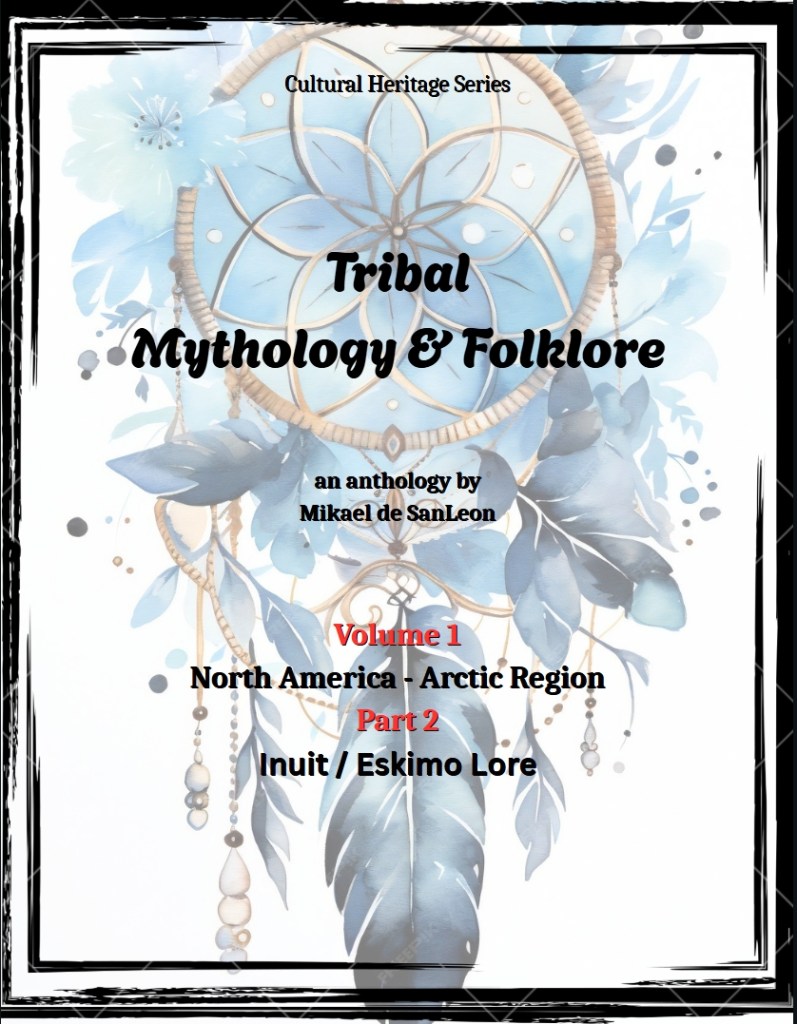
Inuit/Eskimo Lore: the Book

Collector’s Edition

The volume contains over 300 stories from famous monographs like “Tales and Traditions of the Eskimo” by Henry Rink, “Eskimo Folk-Tales” by Knud Rasmussen, “The Labrador Eskimo” by E.W. Hawkes, “Tales of the Smith Sound Eskimo” by Alfred L. Kroeber, “The Central Eskimo” by Franz Boas, “Ethnology of the Ungava District” by Lucien M. Turner, “The Eskimo around Bering Strait” by Edward W. Nelson, etc. Many of the stories are published in our site. Yet, the book contains extensive studies, notes and comments from the authors, critical for understanding the Inuit culture, that are not published online.
Free access to all our supporters.

Origin of the people of Diomede Islands and at East Cape, Siberia

Two origin myths from Arctic regions describe the beginnings of their communities. On Big Diomede Island, it’s believed the first humans descended from the sky. A man carved ten figures from ivory and wood, which transformed into men and women, ancestors of the islanders. Similarly, Siberian Eskimos trace their lineage to a man and woman arriving in stone-transformed kaiaks, with their descendants populating East Cape.

Source: 
The Eskimo about Bering Strait 
by Edward William Nelson 
[Smithsonian Institution] 
Bureau of American Ethnology 
Eighteenth Annual Report 
Washington, 1900


► Themes of the story

Creation: These tales explain the origins of the first humans in their respective regions, detailing how life began for their communities.

Origin of Things: They provide explanations for natural phenomena and cultural practices, such as the transformation of carved figures into humans and the petrification of kaiaks into stones.

Supernatural Beings: The involvement of mystical transformations and otherworldly events highlights interactions with supernatural elements in these origin myths.

► From the same Region or People

Learn more about Inuit peoples


An old man from the Diomede islands told me that it was believed among his people that the first human beings who came to Big Diomede island were a man and a woman who came down from the sky and lived on the island a long time, but had no children. At last the man took some walrus ivory and carved five images of people. Then he took some wood and made five more images from it and put all of them to one side.

The next morning the ten dolls had become transformed into ten people. Those coming from the ivory dolls were men, being hardy and brave, and those from the wood were women and were soft and timid. From these people came the inhabitants of the islands.

► Continue reading…

An Eskimo living at East cape, Siberia, told me that the first Eskimo who lived on East cape were a man and a woman who came there in two kaiaks from St Lawrence island. The kaiaks turned to stone when, the pair landed, and two peculiarly shaped stones, one on each side of the cape, are pointed out as being these kaiaks. From this pair of people came all of the Siberian Eskimo.

In those days there were two kinds of people on East Cape, who could not understand each other, but after a time the other people went away and only the Eskimo were left, as they are today.


Running and expanding this site requires resources: from maintaining our digital platform to sourcing and curating new content. With your help, we can grow our collection, improve accessibility, and bring these incredible narratives to an even wider audience. Your sponsorship enables us to keep the world’s stories alive and thriving. ♦ Visit our Support page

Migration legend

Long ago, the Eskimos migrated from the east to the Yukon River, building a large village. Internal conflict divided them, leading to wars with surrounding groups. Survivors dispersed to locations like Kushunuk, Nunivak Island, and Bristol Bay. Over time, they faced conflicts with Kodiak and Aleut forces, relocating repeatedly. Language differences emerged as groups settled in distinct areas, with descendants eventually resettling near Goodnews Bay.

Source: 
The Eskimo about Bering Strait 
by Edward William Nelson 
[Smithsonian Institution] 
Bureau of American Ethnology 
Eighteenth Annual Report 
Washington, 1900


► Themes of the story

Conflict with Authority: The internal conflicts and wars among the Eskimo groups and with surrounding communities highlight struggles against oppressive forces.

Community and Isolation: The dispersal of the Eskimo people into separate groups and their eventual resettlement illustrate themes of belonging and estrangement.

Echoes of the Past: The narrative reflects on ancestral migrations and conflicts, emphasizing their influence on the present settlements and cultural differences.

► From the same Region or People

Learn more about Inuit peoples


The following legend was obtained from an old man at Ikogmut, on the Lower Yukon. I had no opportunity of verifying any part of it, which was given as a statement of fact.

Very long ago the Eskimo lived far away from the Yukon, and were continually moving from place to place; traveling from the far east to the west. After long wanderings some of them built a village on the bank of Yukon river, just below where Ikogmut now stands, which increased in size until there were thirty-five kashims. The ruins of this village can be seen at the present time, with large pits where the kashims stood.

Finally the villagers quarreled, formed two parties, and made war against each other. The inhabitants of the surrounding villages had hated these people for a long time on account of their overbearing manner, and when they began to quarrel among themselves the out side people united to make war upon them. These enemies were so powerful that they were able to defeat the divided forces of the villagers in a battle, and those who survived became separated into three parties and dispersed.

► Continue reading…

One party stopped at the village of Kushunuk, near Cape Vancouver; another party went to Nunivak island, and another traveled on until it reached Bristol bay, and settled near where Nushagak now stands. The people on the great island of Kodiak, having heard of the strangers near Nushagak, sent a war party across from the island to attack them, but the newcomers on Bristol bay succeeded in almost exterminating them. After this the Aleut, on the island of Uminak, heard of the strangers, and of their having defeated the Kodiak men, so they sent out a war party against these people. This time the Yukon men were defeated and lost half their number. Those who were left then joined with some of their friends from Nunivak island and attacked the people living at Goodnews bay, below the mouth of Kuskokwim river, killing them and burning their village.

The victors then built themselves a village in the same locality, where they were living at the time the Russians came to the country. When the Russians came the people on Goodnews bay resisted them for some time, but finally they scattered, some going back to Bristol bay and others settling with their people on Nunivak island. Since then the descendants of these people have gradually returned to Goodnews bay, where they are now living. During the last few years the people on Bristol bay have been gradually working along the coast toward the mouth of the Kuskokwim.

During the time of the migration from the Yukon all of these people spoke one tongue, but having settled at three widely separated places, their languages gradually became different, the people living at Bristol bay and on Nunivak island being nearest alike in speech.


Running and expanding this site requires resources: from maintaining our digital platform to sourcing and curating new content. With your help, we can grow our collection, improve accessibility, and bring these incredible narratives to an even wider audience. Your sponsorship enables us to keep the world’s stories alive and thriving. ♦ Visit our Support page